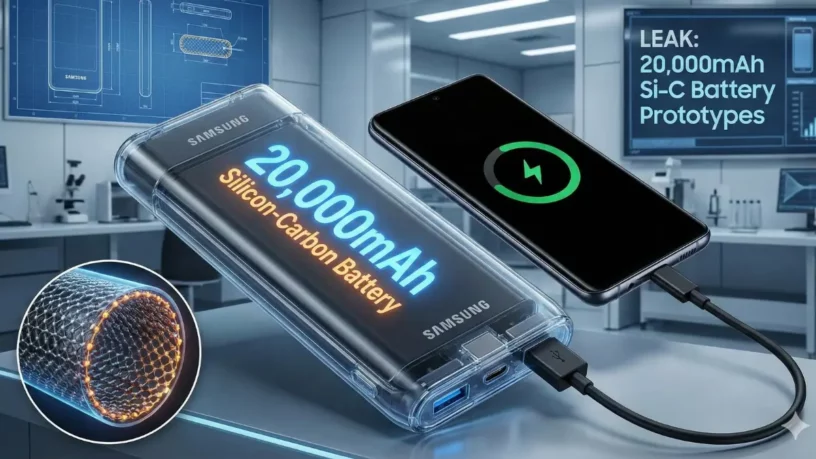
Samsung is reportedly working on a 20,000mAh silicon-carbon battery, according to recent leaks that detail an experimental dual-cell prototype under development by Samsung SDI. The experimental battery design combines two cells — allegedly a 12,000mAh unit and an 8,000mAh unit — to achieve an unprecedented 20,000mAh capacity for mobile devices.
This capacity would be roughly four times the battery size found in current flagship smartphones, highlighting the potential of silicon-carbon battery materials to dramatically boost energy density.
What the Leak Claims About Samsung’s 20,000mAh Silicon-Carbon Battery
Dual-Cell Prototype Under Test
Leaked information suggests the prototype uses a dual-cell architecture with a combined 20,000mAh capacity, enabled by silicon-carbon composite technology. This could theoretically support extended device runtime far beyond today’s standards.
Technical Challenges and Safety Issues
Multiple sources report the prototype faced significant swelling issues during testing, especially in the secondary cell — a known safety concern for high-capacity battery designs. The swelling could affect durability and device fit, making consumer-ready deployment uncertain.
No Official Confirmation Yet
Samsung has not officially confirmed or denied the leaked claims. So these reports should be treated as early-stage developments rather than imminent product announcements.
What This Means for Smartphone Batteries
Silicon-carbon battery technology aims to replace traditional graphite anodes with silicon-enriched composites, increasing the amount of charge stored per cycle without proportionally increasing weight or volume. While some OEMs have already released devices with extended battery capacities using silicon-carbon blends, a 20,000mAh battery remains experimental.
If Samsung can solve the technical hurdles, such a battery would represent a substantial leap in mobile endurance, potentially delivering multi-day usage between charges. However, safety and manufacturing challenges must be resolved before commercial use.