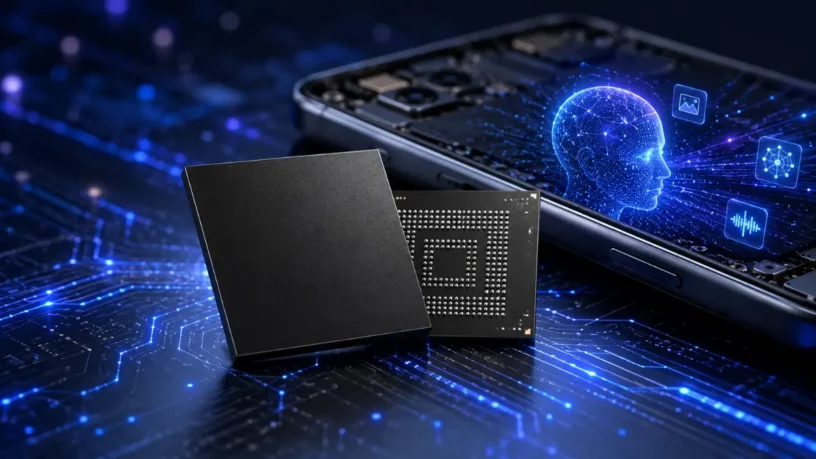
Samsung has announced its next-generation UFS 5.0 storage, positioning it as a major step forward for smartphones and mobile devices built around on-device AI workloads. The company is targeting applications that demand sustained high throughput, including generative AI processing, real-time video, and advanced computational photography.
The new standard pushes beyond the limits of current UFS 4.0 implementations, focusing on both raw speed and power efficiency. Samsung says the upgrade is designed not just for faster file transfers, but for handling continuous, data-heavy tasks without bottlenecks.
Faster throughput, higher efficiency
Samsung’s UFS 5.0 delivers sequential read speeds of up to 10.8GB/s and write speeds reaching 9.5GB/s. That’s roughly double what typical UFS 4.1 storage offers today, which generally peaks around 4–7GB/s depending on implementation.
Those numbers matter less in isolation than in sustained workloads. On-device AI models, especially large language and vision models, require continuous data streaming between storage and memory. Higher throughput reduces latency and helps maintain consistent performance during extended tasks.
Samsung is also emphasizing improvements in power efficiency. The company claims UFS 5.0 is 40% power efficient compared to UFS 4.1. Faster storage alone isn’t useful if it drains the battery or triggers throttling.
Context within the current UFS roadmap
UFS 4.0 began appearing widely in flagship devices only over the past two years, including Samsung’s Galaxy S series and several high-end Android phones from Chinese OEMs. That standard already represented a major leap over UFS 3.1, particularly in sequential speeds and energy efficiency.
UFS 5.0 extends that trajectory, but it also shifts the focus. Earlier generations primarily improved app load times and file transfers. This iteration is clearly aligned with AI-driven use cases, where storage acts as a constant data pipeline rather than a passive repository.
There’s also a timing question. The broader ecosystem — including controllers, SoCs, and software optimization — needs to catch up before UFS 5.0 can be fully utilized. Without that alignment, peak speeds may remain theoretical in early devices.
What it means for real-world devices
In practice, users may not notice a difference in everyday tasks like opening apps or copying files. Those operations are already fast on UFS 4.0 devices.
The gains become more relevant in heavier scenarios. Running on-device generative AI, editing high-resolution video, or processing large photo batches could benefit from faster and more consistent data access. Multitasking under load may also feel smoother as storage becomes less of a bottleneck.
Thermal behavior will be just as important as speed. If Samsung’s efficiency claims hold up, UFS 5.0 could enable longer sustained performance without aggressive throttling — a common issue in current flagship phones.
Samsung hasn’t confirmed commercial rollout timelines, but early adoption will likely start in premium devices before filtering down. The bigger question is how quickly mobile chipsets and software frameworks evolve to fully leverage the additional bandwidth.