A new Samsung chipset has quietly entered the benchmarking cycle. The Samsung Exynos 2700 has now been spotted on Geekbench for the first time, offering an early look at CPU and GPU performance.
The listing, shared by tipster Abhishek Yadav on X, who also revealed early Geekbench GPU numbers for Exynos 2700 in January 2026, reveals both core configuration details and synthetic scores. As with all pre-release benchmarks, these numbers should be treated cautiously, but they do begin to outline where Samsung’s next chip could land.
Early Geekbench numbers
According to the listing, the Exynos 2700 scores 2,603 on single-core and 10,350 on multi-core. That places it within striking distance of recent flagship-class silicon, though not necessarily ahead.
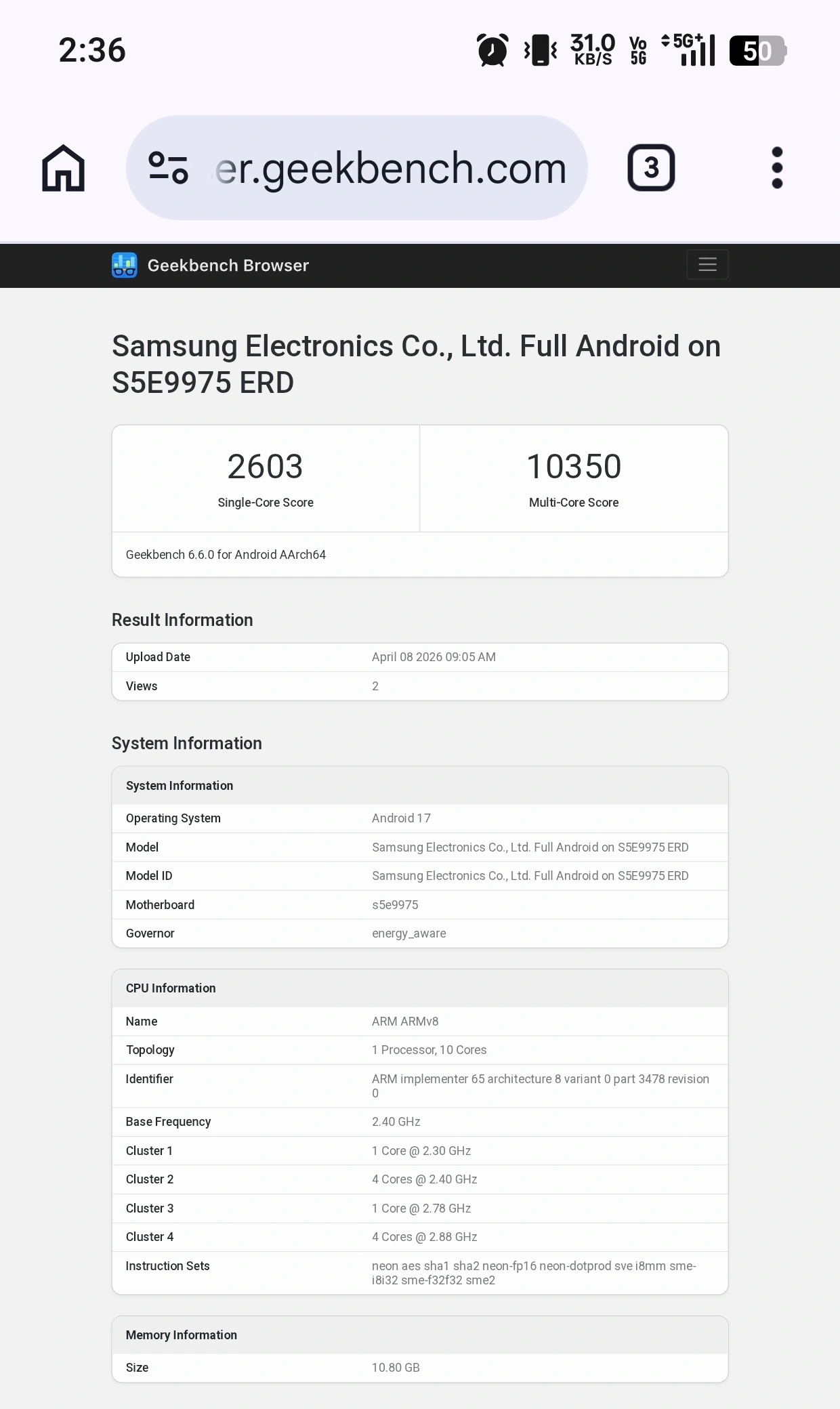
The CPU itself uses a deca-core layout, which is unusual compared to the more common octa-core designs. The breakdown is as follows:
- 1 core at 2.30GHz
- 4 cores at 2.40GHz
- 1 core at 2.78GHz
- 4 cores at 2.88GHz
This suggests a layered performance structure rather than a simple “prime + performance + efficiency” setup. Samsung appears to be experimenting with more granular scaling across workloads.
On the graphics side, the chip integrates the Xclipse 970 GPU, continuing Samsung’s AMD-based GPU branding.
The test device was running Android 16 with 12GB of RAM, indicating this is likely a development platform rather than a finalized consumer device.
Context and comparisons
These CPU scores put the Exynos 2700 roughly in line with upper midrange to lower flagship silicon from the current generation. Chips like Snapdragon 8 Gen 3 and Dimensity 9300 still push higher multi-core figures in most public runs.
That said, Geekbench results often fluctuate significantly during early testing. Clock speeds can change, core scheduling may not be finalized, and thermal tuning is usually incomplete.
The deca-core layout also complicates direct comparisons. More cores don’t always translate to better real-world performance, especially if workloads aren’t optimized to take advantage of them.
GPU performance remains an open question. Samsung’s Xclipse line has historically focused on features like ray tracing support, but raw throughput has sometimes lagged behind Qualcomm’s Adreno GPUs.
What it could mean in practice
Synthetic scores only tell part of the story. Day-to-day performance depends heavily on software optimization, sustained performance, and thermal efficiency.
If Samsung can improve scheduler behavior and heat management, the Exynos 2700 could close the gap in real-world usage even if benchmark numbers look conservative.
Battery efficiency will also be critical. A more complex core arrangement can either help with fine-tuned power scaling or introduce inefficiencies if not handled properly.
Gaming is another area to watch. The Xclipse 970’s OpenCL score doesn’t stand out yet, but drivers and game-level optimization often evolve significantly before launch.
There’s also the broader question of where this chip will land. Whether it powers select Galaxy flagships or remains region-specific could shape how widely its performance is scrutinized.