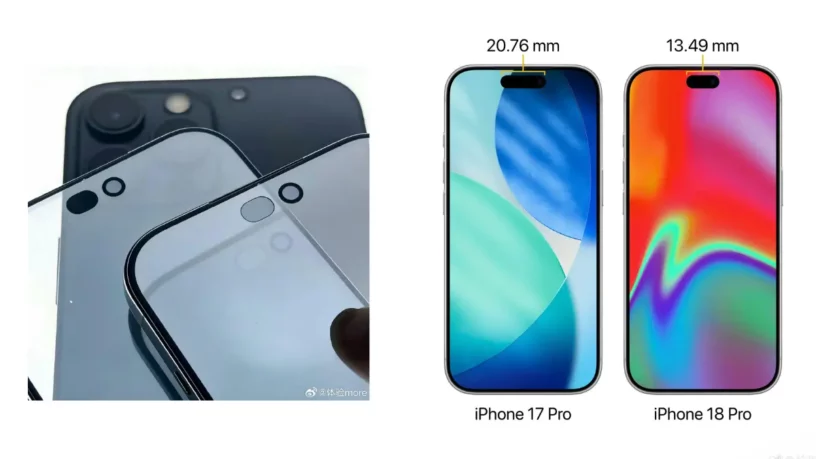
A new set of screen protector images, shared by a Weibo user, offers an early look at what could be a notable display change on Apple’s next Pro iPhone. The accessory, typically aligned with final hardware dimensions, suggests the Dynamic Island cutout is getting smaller.
That lines up with ongoing expectations around under-display component shifts, though the implementation here looks more incremental than a full redesign.
Smaller cutout with internal reshuffle
The leaked protector shows a noticeably reduced pill-shaped cutout at the top of the display. According to the source, the visible “island” area is roughly 35% smaller.
The change appears to come from moving the flood illuminator beneath the display panel. That would leave the front-facing camera, infrared camera, and dTOF sensor still housed within the visible cutout.
This approach aligns with Apple’s gradual transition strategy. Instead of eliminating the Dynamic Island entirely, the company seems to be shrinking its footprint by relocating individual components under the display as the technology matures.
Apple’s display strategy favors gradual sensor migration
Apple has been linked to under-display Face ID for several product cycles, but progress has been uneven. Early implementations in the Android space have struggled with image clarity and sensor reliability, particularly for biometric systems.
Shrinking the cutout rather than removing it outright suggests Apple is prioritizing consistency over aggressive design shifts. Face ID accuracy remains a core differentiator, and any compromise there would be noticeable.
The reported 35% reduction is also consistent with the incremental hardware consolidation seen in previous iPhone generations. Apple has steadily reduced notch and cutout sizes since the iPhone X, without rushing into fully hidden sensors.
Real-world implications
A smaller Dynamic Island changes less than it might seem at first glance.
The interface itself is software-driven, so its behavior likely remains identical. However, a reduced physical footprint could make full-screen content—especially video and gaming—feel slightly less obstructed.
It may also allow Apple to refine UI layouts. Developers currently design around the island’s size; a smaller cutout gives more usable pixels near the top edge, even if only marginally.
Still, the bezel size reportedly remains unchanged from the iPhone 17 series. That limits how dramatic the visual shift will feel in everyday use.
The more interesting question is timing. If Apple is already moving one Face ID component under the display, the remaining sensors could follow in future iterations. Whether that leads to a true all-screen iPhone—or simply an even smaller island—may depend on how quickly under-display camera quality improves.