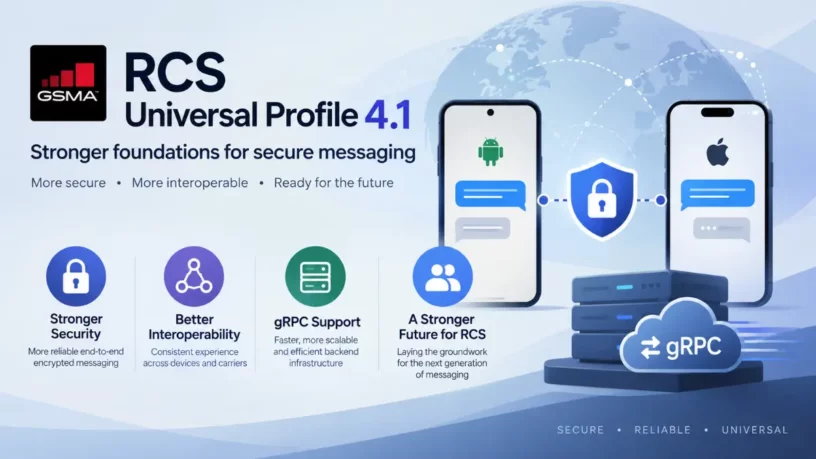
The GSMA has announced RCS Universal Profile 4.1, introducing a new set of specifications that strengthen the foundation for secure messaging across the Rich Communication Services (RCS) ecosystem. Rather than adding consumer-facing features, this release focuses on improving the technical framework that enables end-to-end encrypted messaging to work consistently across different devices, apps, and mobile operators.
The update builds on the progress made with RCS Universal Profile 3.0, which introduced standardized end-to-end encryption based on the Messaging Layer Security (MLS) protocol. Version 4.1 further refines those capabilities, helping developers, mobile operators, and device makers implement secure messaging more reliably while improving interoperability across platforms.
One of the more notable additions is support for gRPC, a modern remote procedure call framework widely used in cloud-native systems.
Stronger technical foundation for encrypted messaging
According to the GSMA, Universal Profile 4.1 focuses on reinforcing the underlying architecture of RCS rather than introducing visible interface changes. The updated specifications improve how secure messaging is implemented, making it easier for ecosystem partners to deploy interoperable encryption while maintaining compatibility across networks and devices.
The release comes at a time when RCS adoption is accelerating across the industry. Apple’s addition of RCS support in iOS and Google’s continued investment in Google Messages have expanded the protocol beyond Android, making cross-platform compatibility a higher priority than ever. As more manufacturers and carriers adopt the same technical standards, users are more likely to experience consistent messaging features across phones.
gRPC support modernizes the RCS backend
Universal Profile 4.1 introduces gRPC as an alternative to legacy REST-based interfaces used in RCS infrastructure. gRPC, originally developed by Google, is designed for efficient, low-latency communication between services using HTTP/2 and binary data formats.
In practice, this allows mobile operators and service providers to build faster, more scalable messaging systems. gRPC handles real-time communication more efficiently than traditional REST APIs, especially for persistent connections and rapid message exchanges.
That change matters at scale. RCS is increasingly expected to handle not just person-to-person chats, but also business messaging, authentication flows, and media-heavy conversations. A more efficient backend reduces delays and improves reliability under heavy load.
What this means for users
While most users won’t notice any immediate visual changes after the publication of Universal Profile 4.1, the update could deliver several long-term benefits as manufacturers and messaging providers adopt the new specifications.
A stronger security framework means encrypted conversations can be more reliable across different messaging clients, rather than depending on proprietary implementations. That is particularly important for conversations between Android and iPhone users, where standardized encryption has historically lagged behind platform-specific services like iMessage.
The updated profile also helps improve interoperability. Instead of each company implementing its own interpretation of RCS features, a common specification reduces compatibility issues between carriers, devices, and messaging apps. Over time, that should translate into a more consistent messaging experience with fewer feature mismatches.
Developers and mobile operators also benefit from clearer implementation guidance, which can accelerate deployment of future RCS capabilities without fragmenting the ecosystem. Although Universal Profile 4.1 is primarily a standards update, it lays the groundwork for future messaging enhancements while keeping security at the center of the platform.
A gradual rollout remains likely
Publishing a Universal Profile does not automatically make its features available to users. Device manufacturers, messaging app developers, and mobile carriers must first integrate the updated specifications before they appear in consumer devices. That means adoption will likely happen over several software updates rather than through a single global rollout.
With RCS becoming the common messaging standard across Android and iPhone, each specification update carries more weight than before. Universal Profile 4.1 may not introduce headline-grabbing features, but its focus on stronger security and interoperability could make future cross-platform conversations more private, reliable, and consistent once the broader ecosystem catches up.