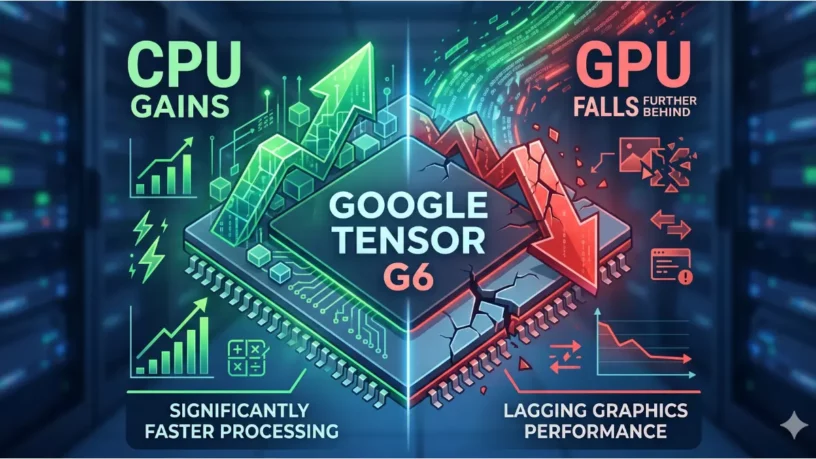
Google’s next in-house chipset, expected to power the Pixel 11 series, is shaping up to be a study in trade-offs. Early details around the Tensor G6 point to a meaningful CPU upgrade, paired with a GPU choice that already looks dated on paper.
That split approach isn’t new for Tensor. But this time, the gap between strengths and weaknesses appears wider.
At the center of the G6 is a redesigned CPU cluster built on newer ARM cores. The layout shifts to a 7-core setup, down from eight, arranged as 1+4+2. The prime core, labeled C1 Ultra, is clocked at 4.11GHz. It’s backed by four C1 Pro cores at 3.38GHz and two efficiency-oriented C1 Pro cores at 2.65GHz.
This configuration mirrors trends seen in flagship silicon elsewhere, including MediaTek’s Dimensity 9500, which is expected to use a similar top-tier core. The reduction in core count likely reflects die size and cost considerations rather than a performance ceiling.
In practice, this should translate to better single-core speed and improved efficiency under mixed workloads. Day-to-day use responsiveness could see a lift, especially in UI navigation and app launches.
GPU remains the limiting factor
Graphics, however, tell a different story.
The Tensor G6 is said to use a PowerVR CXT-48-1536 GPU, an architecture dating back to 2021. That puts it roughly five years behind the curve by the time the Pixel 11 launches.
The implications are straightforward. Gaming performance is expected to lag behind competing chips from Qualcomm and MediaTek. Driver support is another concern, especially with the lack of Vulkan 1.4 compatibility. That could affect not just games, but also certain rendering and compute tasks.
This isn’t a small gap. It’s structural.
Strategy shifts toward AI and efficiency
The broader design suggests Google is prioritizing cost control and silicon area efficiency. A smaller die typically improves yield and margins, but it forces trade-offs in components like the GPU.
Instead, the company appears to be doubling down on its NPU and AI stack. Tasks that would traditionally lean on GPU acceleration may increasingly be routed through dedicated AI hardware.
That aligns with how Pixel devices have evolved. Features like image processing, voice recognition, and on-device AI have long been Tensor’s focus. The G6 seems to push further in that direction.
A new Titan M3 security chip is also expected, continuing Google’s emphasis on hardware-level protection for encryption keys and biometric data.
Context against rivals
Even with CPU gains, Tensor still trails the broader flagship field.
The Pixel 10, powered by Tensor G5, already showed a noticeable gap in sustained performance and graphical fluidity compared to Snapdragon and Dimensity counterparts. Animations were smooth, but under load, the difference became clear.
The G6 may narrow that gap in short bursts. It likely won’t close it.
That leaves the Pixel 11 in a familiar position. Strong software optimization, distinctive AI features, and a cohesive user experience. But underneath, hardware that doesn’t fully match its price bracket.
The open question is whether users will continue to accept that trade-off, especially as mobile gaming and high-refresh interfaces become baseline expectations rather than niche use cases.