Official CAD-based renders of the Google Pixel 11 Pro Fold have surfaced, offering the first detailed look at Google’s next book-style foldable ahead of its expected launch later this year.
Images shared by Android Headlines, in partnership with OnLeaks, show a device that closely follows the design language of its predecessor while reducing thickness and refining the rear camera module. There are no radical changes here. Instead, Google appears to be iterating.
That may be the point.
Familiar silhouette, slimmer body
At a glance, the Pixel 11 Pro Fold looks nearly identical to the Google Pixel 10 Pro Fold. The overall footprint remains the same, with dimensions measuring 155.2 x 150.4mm when unfolded.
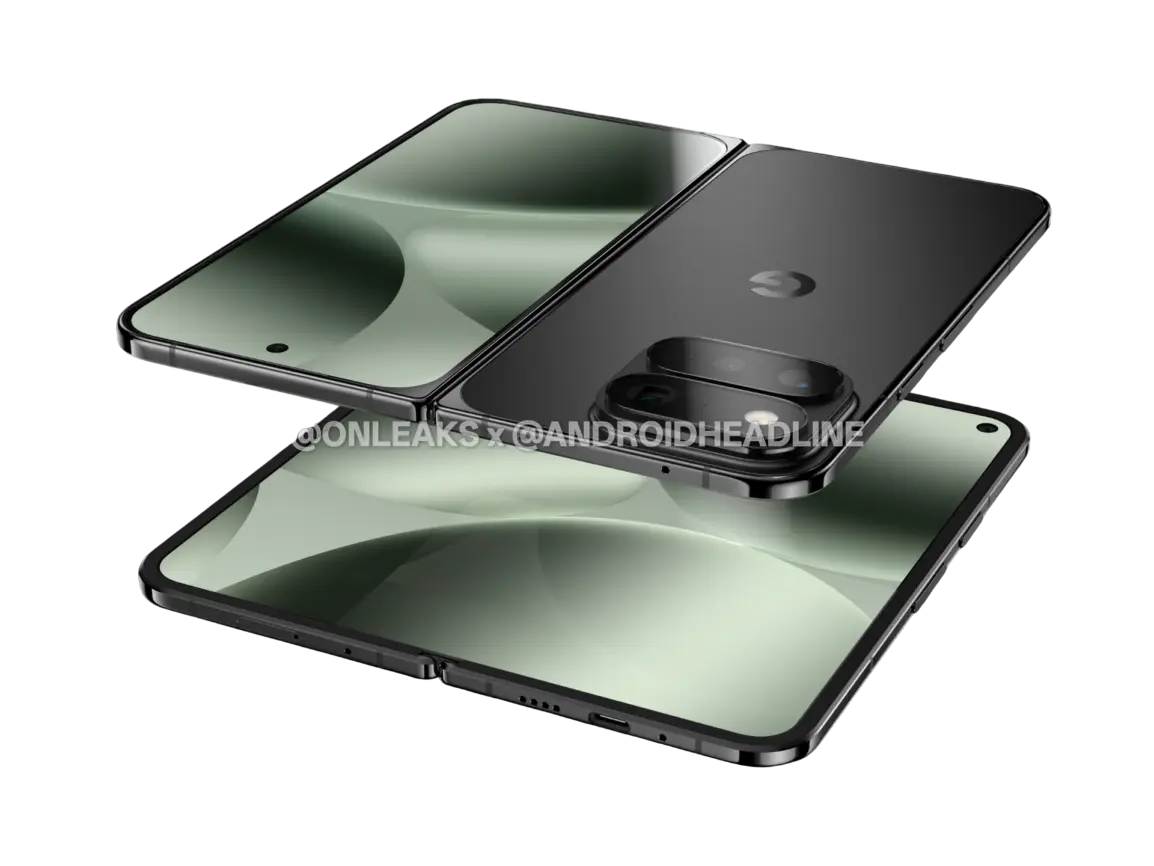
Thickness is where the changes begin. According to the CAD data, the new model comes in at 10.1mm when folded, down from 10.8mm. Unfolded, it measures 4.8mm, compared to 5.2mm on the previous generation. That’s a reduction of 0.7mm folded and 0.4mm unfolded.
The difference sounds minor on paper. In hand, even sub-millimeter reductions can improve grip and pocketability, particularly in a category where some rivals have already dipped below 9mm folded.
The frame appears to remain aluminum, paired with a glass back panel. The inner display retains a top-right hole-punch cutout, while the bezels around the foldable panel are uniform and slightly raised, doubling as protection when the device is shut. The cover display layout also looks unchanged.
Ports and button placement are consistent with last year’s model. USB-C, speaker grille, microphone, and SIM tray sit along the bottom edge. The power button and volume rocker remain stacked on the right side.
Camera bump gets a cleaner look
The most visible design change is on the back.
The Pixel 11 Pro Fold adopts a revised camera island with more pronounced curvature where it meets the rear panel. The LED flash and microphone now sit within the upper pill-shaped cutout alongside one of the cameras, rather than being separated. The result is a cleaner, more consolidated layout.
It’s not a dramatic redesign, but it gives the device a more polished rear profile.
Hardware details for the camera system have not been confirmed. The Pixel 10 Pro Fold trailed both the Pixel 10 and Pixel 10 Pro in camera hardware, particularly with its ultrawide sensor. Given how aggressively competitors have upgraded foldable camera systems, Google may need to respond.
Whether that means larger sensors or simply better tuning remains unclear.
Tensor G6 expected under the hood
Internally, the Pixel 11 Pro Fold is expected to debut Google’s next-generation chipset, the Tensor G6. The prior model used the Tensor G5.
Early rumors suggest the G6 could be manufactured on a 3nm process by TSMC and may adopt a 7-core CPU configuration. Those details remain unverified. Still, a shift to 3nm would likely improve efficiency and sustained performance, particularly in thermal-constrained foldable hardware.
Memory configurations are expected to mirror the current model, with 16GB of RAM and storage options up to 1TB. Display sizes also appear unchanged, including the 8-inch LTPO OLED main panel and 6.4-inch cover screen.
Battery capacity is rumored to hover around 5,000mAh, similar to the 5,015mAh cell in the Pixel 10 Pro Fold. Charging speeds are not expected to see major upgrades.
Pricing is less predictable. Earlier roadmap information pointed to a $1,500 target, but shifting component costs and tariffs could push the price closer to, or even above, the $1,799 starting point of the current generation. Foldables remain expensive across the board, and Google has shown little appetite for aggressive discounting at launch.
If the company sticks to its recent release cadence, an August announcement is likely.
The Pixel 11 Pro Fold doesn’t attempt to redefine Google’s foldable strategy. It refines it. The question now is whether thinner hardware and a new Tensor chip will be enough in a segment that is evolving faster each year.