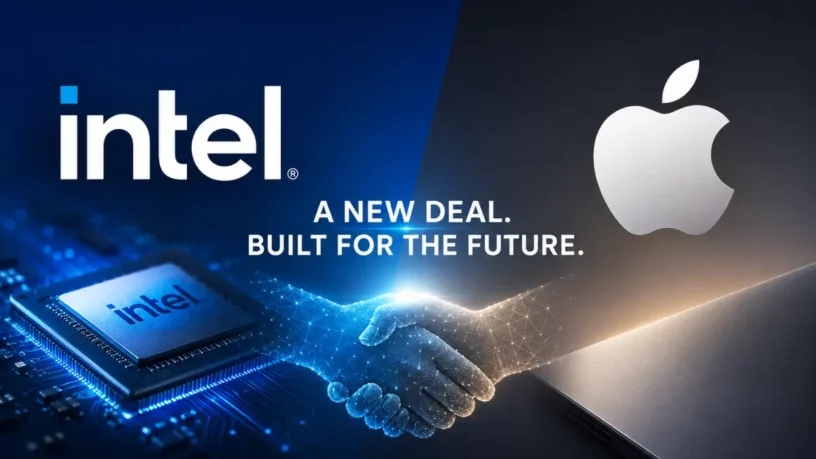
Apple may finally be preparing for a future where TSMC is no longer the only company capable of building its chips at scale.
According to a report from the Wall Street Journal, Apple and Intel have reached a “preliminary” agreement that would allow Intel Foundry to manufacture some chips used in Apple devices. The report also claims the arrangement could extend to the A27 chips expected to power the rumored MacBook Neo lineup.
That detail matters more than it initially appears.
For years, Apple’s relationship with TSMC has been one of the strongest partnerships in the semiconductor industry. Apple receives early access to advanced process nodes, while TSMC gains a customer willing to absorb enormous production volumes. The arrangement helped Apple build a massive lead in laptop efficiency after the transition from Intel x86 processors to Apple Silicon.
But the AI boom has changed the economics of chip manufacturing.
AI demand is starting to reshape consumer chip priorities
TSMC’s most advanced fabrication lines are now under pressure from nearly every major AI company. NVIDIA, AMD, Qualcomm, MediaTek, and even cloud providers are competing for the same high-end wafer capacity used to manufacture advanced processors.
Apple can still secure leading-edge production for flagship chips like the M-series or A-series processors used in premium iPhones. The problem is scale. Entry-level devices generate huge shipment volumes, often with tighter profit margins.
That creates a logical opening for Intel.
Instead of replacing TSMC for flagship silicon, Intel could become a secondary manufacturing partner focused on lower-priority or mainstream chips where absolute performance leadership matters less than stable supply and production flexibility.
The rumored MacBook Neo fits that profile almost perfectly.
If Apple positions the Neo as a lower-cost MacBook aimed at students or emerging markets, production consistency becomes just as important as benchmark dominance. A slight efficiency gap would matter far less if Intel could help Apple avoid shortages during peak demand periods.
This could be Intel Foundry’s biggest credibility test yet
Intel has spent the past few years aggressively pushing its foundry ambitions under CEO Pat Gelsinger. The company wants to manufacture chips not just for itself, but also for external clients in the same way TSMC and Samsung already do.
Winning Apple in any capacity would be a major validation.
Not because Intel suddenly becomes Apple’s primary chipmaker, but because Apple is notoriously selective about manufacturing reliability, yields, and process maturity. Even a limited production contract suggests Intel’s fabs may finally be reaching a level Apple considers commercially viable.
There is another angle here, too.
Apple moving a portion of production to Intel would reduce geographic concentration risk. Nearly all of Apple’s advanced chips currently depend on Taiwanese manufacturing. Diversifying production across multiple regions has become increasingly important as semiconductor supply chains face geopolitical uncertainty and export-control pressures.
That may ultimately be the bigger story than the MacBook Neo itself.
Apple spent years reducing dependence on Intel processors. Now it may rely on Intel factories instead. The distinction highlights how the modern chip industry has changed: architecture leadership and manufacturing leadership are no longer guaranteed to belong to the same company.