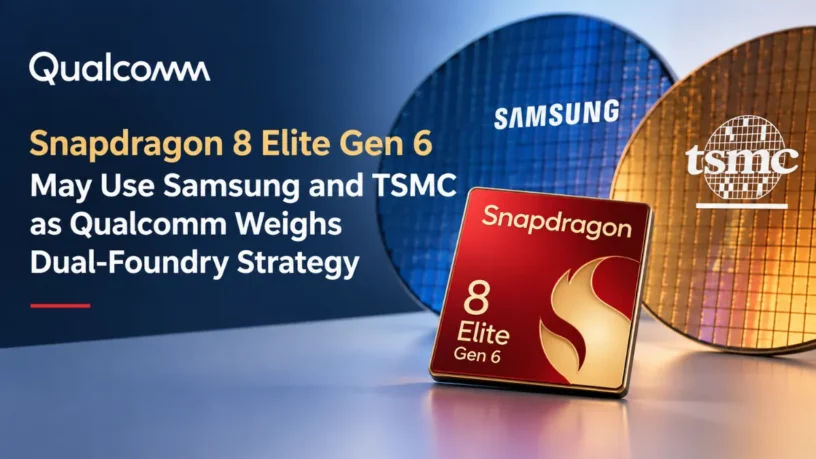
Qualcomm may be preparing to split production of its next flagship mobile platform between TSMC and Samsung as capacity constraints and rising advanced-node costs complicate its foundry strategy.
According to IT Home, citing a September 13 report from South Korea’s Chosun Ilbo, Qualcomm and Samsung Electronics have resumed detailed discussions over manufacturing the Snapdragon 8 Elite Gen 6 on Samsung’s 2nm process. If they reach an agreement, Qualcomm could move away from relying exclusively on TSMC for its flagship chip.
The potential change comes just days before Qualcomm’s 2026 Snapdragon Summit, where the company is expected to introduce the Snapdragon 8 Elite Gen 6 series.
Qualcomm could split production by chip tier
The reported plan would not necessarily mean Samsung takes over production of the entire Snapdragon 8 Elite Gen 6 lineup.
Sources cited by Chosun Ilbo indicate that Qualcomm could use a tiered manufacturing strategy. The highest-end version, described as the Extreme model, would likely remain with TSMC because of its tighter performance and power-efficiency requirements.
Meanwhile, Samsung could manufacture some standard versions or specific configurations using its 2nm gate-all-around process.
That arrangement would give Qualcomm another source of advanced-node capacity without immediately shifting its most demanding designs away from TSMC.
| Foundry | Potential Snapdragon 8 Elite Gen 6 role | Reported 2nm yield |
|---|---|---|
| TSMC | Extreme/high-end version | 80–90% |
| Samsung | Standard models or selected configurations | 70%+ |
The yield figures come from the reports cited by IT Home and have not been independently verified.
Samsung’s reported 2nm GAA yield has improved significantly, rising from below 50% in early 2026 to more than 70%. That is around the 70% yield benchmark Qualcomm reportedly sought for mass production, although TSMC is said to have reached substantially higher yields of 80% to 90%.
TSMC capacity is becoming a problem
Capacity appears to matter as much as process performance.
IT Home reports that TSMC plans to raise its 2nm monthly production capacity to 60,000 wafers by the fourth quarter of 2026. However, Apple has reportedly secured at least half of that capacity for chips including the A20 Pro and M6.
TSMC’s 3nm production is also reportedly heavily committed, with Nvidia and AMD among customers booking capacity through 2027. For Qualcomm, securing enough leading-edge capacity could therefore become increasingly difficult even if TSMC remains its preferred manufacturing partner.
Samsung could provide a second source.
That matters beyond a single Snapdragon generation. Splitting production between foundries would give Qualcomm greater flexibility if capacity becomes constrained, while also reducing its dependence on one manufacturer for flagship processors.
Samsung still has to close the gap
Qualcomm’s renewed discussions with Samsung are notable because the two companies have taken different paths over the past several years.
Qualcomm moved mass production of its flagship Snapdragon processors entirely to TSMC beginning in 2022, following concerns surrounding Samsung’s process yields and thermal performance. TSMC subsequently became the primary manufacturing partner for Qualcomm’s high-end mobile chips.
Samsung’s foundry business has since worked to improve both yield and thermal management. The reported increase in 2nm yield could make the company a more viable alternative, although the reported 70%-plus figure still trails TSMC’s reported 80% to 90% range.
Commercial negotiations also appear difficult.
According to the report, Qualcomm is pushing for lower foundry prices, while Samsung is resisting discounts. Samsung has previously raised prices for some 4nm and 5nm orders by 10% to 15%, and the foundry has reportedly gained customers including Tesla and Broadcom.
With Samsung’s order book strengthening, Qualcomm may have less leverage to demand aggressive pricing.
The split could affect Snapdragon’s production economics
For Qualcomm, a dual-foundry approach could offer more than a simple capacity backup.
Using two manufacturers can add flexibility to supply planning and reduce the risks of concentrating production at one foundry. But it also introduces challenges, particularly when the same chip family is produced using different manufacturing processes.
Qualcomm would need to account for differences in power efficiency, thermals, yields, and potentially chip behavior between Samsung’s and TSMC’s processes. That could make a tiered product strategy more practical than producing identical flagship configurations across both foundries.
The reported negotiations also suggest that Qualcomm is balancing performance against manufacturing economics more closely than it has in recent flagship generations.
Qualcomm’s 2026 Snapdragon Summit is scheduled for September 22–24 in Hawaii, where it is expected to announce the Snapdragon 8 Elite Gen 6 family. Neither Qualcomm nor Samsung has officially confirmed the reported manufacturing discussions, so the final foundry allocation is still unverified.
If the two companies reach an agreement, the Snapdragon 8 Elite Gen 6 could mark Qualcomm’s return to Samsung Foundry for flagship mobile production after several years of TSMC exclusivity — with the final split likely depending as much on wafer pricing and available capacity as on process technology.